Understanding yourself
Climate anxiety and floods
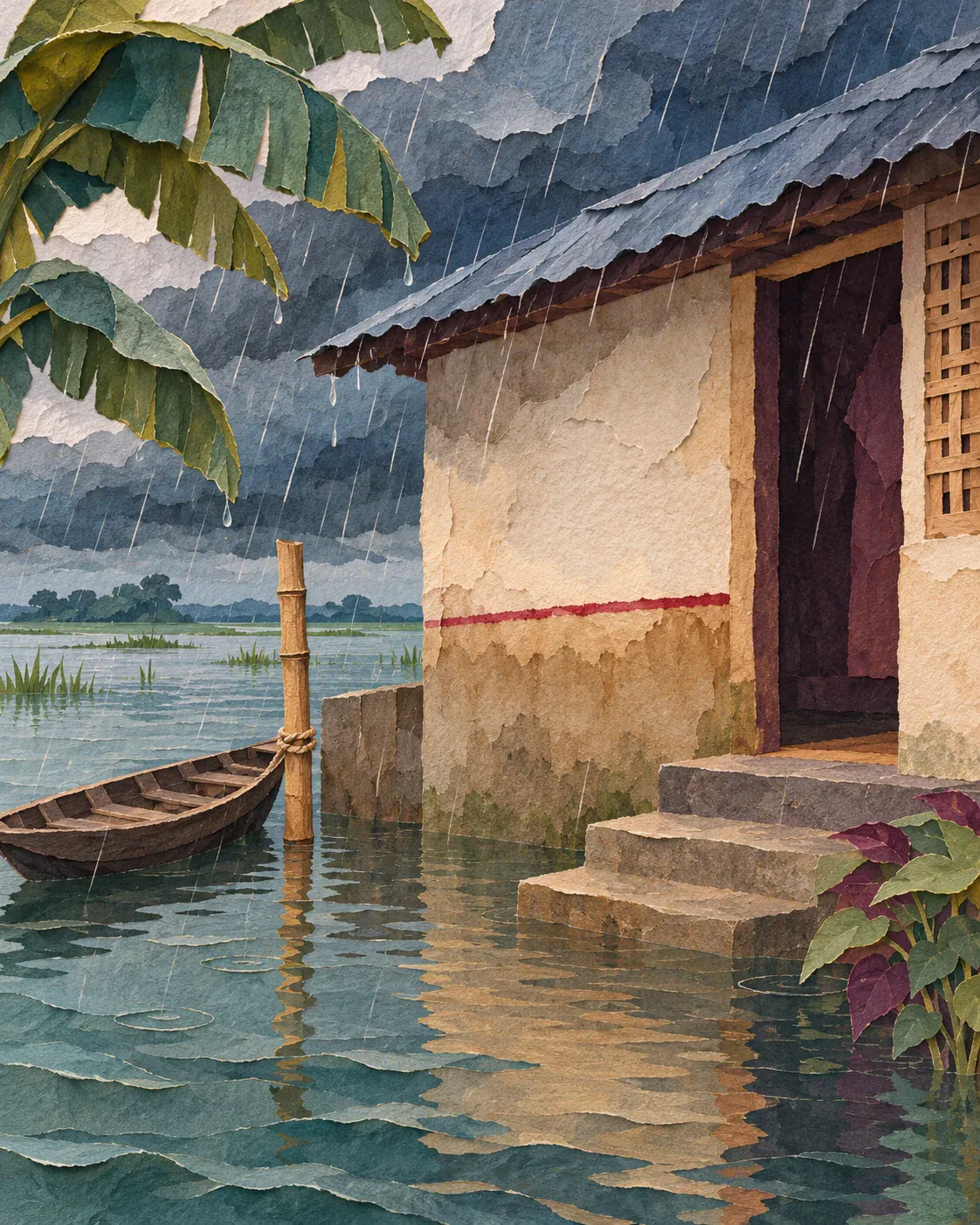
“Every monsoon, the water comes closer to Nanu’s house.”
Worry about floods and a warming world is a sane response to a real threat. When it starts to take over sleep and study, support can help.
June, and rain on the tin roof of the hostel in Mohammadpur where Sohana, 20, studies environmental science. Her phone buzzes with the family WhatsApp group. Her Mama has sent a video of the courtyard of Nanu’s house near Sunamganj, the water already up to the second step. “Don’t worry, ma, only knee deep. Nanu is making khichuri on the high chula.”
Then Nanu herself is on the video call, laughing, her orna tied round her head. “Ei, Dhaka’r meye, have you forgotten how to swim? We’ve seen bigger water than this.” Sohana laughs and wipes her eyes. She was in class twelve when the big flood came and the family spent four days in the school building on high ground, and since then every forecast lands in her body before her mind. She cannot stop reading about sea-level rise, she sleeps badly all monsoon, and she has begun to wonder what a degree is for if Nanu’s village will be gone.
An illustration drawn from common experience. The person is invented; the pattern is not.
Understanding climate anxiety
Climate anxiety is distress about climate change and its effects: worry, grief, anger, helplessness and fear for the future. It is not a diagnosis, and much of it is a reasonable response to a real threat. For people who have lived through floods, it can be bound up with memories of a frightening time. In South and Southeast Asia, a systematic review of 70 studies linked floods, cyclones and riverbank erosion with post-traumatic stress, depression and anxiety. The question that matters clinically is whether the distress can be lived with and acted on, or whether it has started to take over sleep, study and hope.
How common it is
In a survey of 10,000 people aged 16 to 25 in ten countries, 59% were very or extremely worried about climate change, and more than 45% said their feelings about it affected their daily life. In Bangladesh, a nationally representative panel study found that people exposed to flooding in the previous 12 months had higher odds of depression and anxiety. Among 1,200 adolescents from low-income households, those in flood-prone Barisal had about twice the odds of anxiety symptoms, and three and a half times the odds of depressive symptoms, compared with those in Dhaka.
Signs worth noticing
- Worry about climate or floods that fills most days and is hard to switch off
- Poor sleep, especially in the monsoon or around forecasts
- Flashbacks or panic in heavy rain, after living through a flood
- Hopelessness about the future, or losing interest in study and plans
- Avoiding the news completely, or being unable to stop reading it
How care helps
Care starts by treating the feeling as understandable, not irrational. If the worry has become generalised anxiety, UK national guidelines recommend CBT or applied relaxation, or medication, chosen by the person’s preference. If there are flashbacks and nightmares from a flood, an assessment for post-traumatic stress matters, because it has its own specific treatments. Some people find that practical action with others, such as relief work or helping family prepare, turns helplessness into purpose; that is a choice, not a prescription. A psychiatrist will also ask about depression and any thoughts of self-harm.
What getting better can look like
Sohana’s monsoon might include a night when the forecast arrives: she reads it once, calls Mama to check that the boat is ready, sleeps, and in the morning helps her department plan a relief drive.
Common questions about climate anxiety
Is climate anxiety a mental illness?
No. Climate anxiety is not a diagnosis, and worry about a real threat is understandable. It becomes a health concern when it is constant and overwhelming, or stops you sleeping, studying or enjoying life, and then it can be helped like other anxiety.
Do floods affect mental health in Bangladesh?
Research suggests they do. In a nationally representative Bangladesh study, people exposed to flooding in the previous year had higher odds of depression and anxiety, and adolescents in flood-prone Barisal had higher odds of both than adolescents in Dhaka.
When to see a psychiatrist
If fear about floods or the future is taking over your days, or memories of a flood keep coming back, please talk to a doctor. If you have thoughts of ending your life, call 999.
Care here is personal: built around your history, your health and what you want to change, and reviewed with you as it goes.
If some of this sounds familiar, a first conversation is a good place to start. You do not need the right words, or to be certain.
Dr. Tajreen is consulting in Uttar Badda now, until 8:00 pm. Call +880 1847-331010Every address and its hours
Sources
- Hickman et al., Lancet Planetary Health, 2021 (PMID 34895496)
- Wahid et al., Lancet Planetary Health, 2023 (PMID 36754469)
- Goldberg et al., Lancet Planetary Health, 2025 (PMID 40752513)
- Patwary et al., Environmental Research, 2024 (PMID 38354890)
- NICE guideline CG113, Generalised anxiety disorder and panic disorder in adults (last reviewed 11 September 2026)
You do not need to have everything figured out before you begin.