Understanding yourself
Depersonalisation and derealisation
“It’s like watching my life through glass.”
Feeling unreal, or that the world is flat and far away, as if in a film. Frightening and often misunderstood, but not a sign of losing your mind.
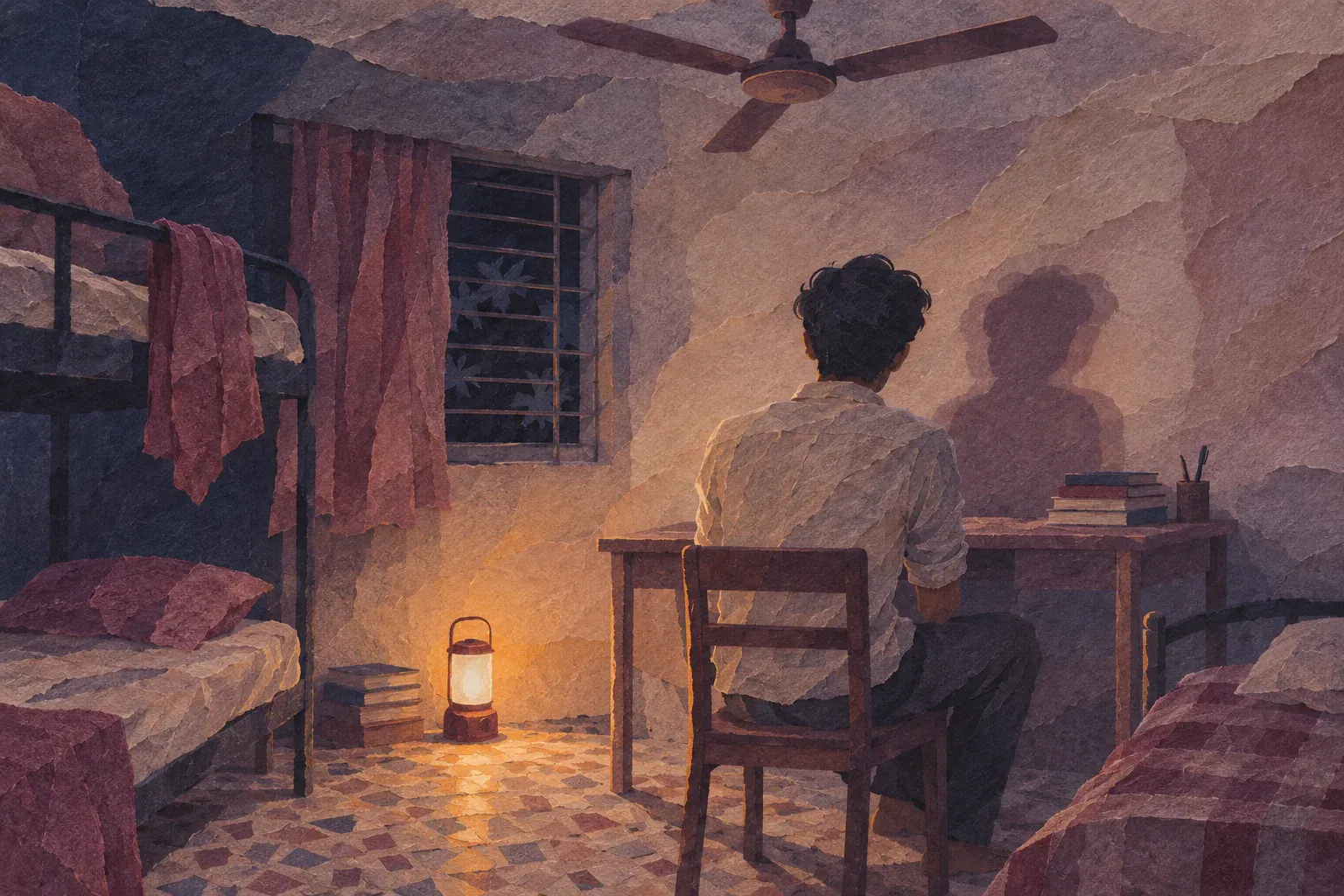
April in Dhaka, and load-shedding again in the mess in Farmgate where Rayhan, 23, a Khulna boy studying engineering, lives with five others. They sit on the roof waiting for the fan to come back, someone’s phone playing old Ayub Bachchu songs. Rayhan looks at his own hand on the parapet, and it seems not quite his. The city lights look flat, like a painting of a city.
It began months ago, after a night of panic before his midterms, and it has not left. He calls Ammu in Khulna every evening. “Baba, have you eaten?” “Yes, Ammu.” He hears his own voice answer as if from the next room. His friend Ratul says, “Tui ki philosopher hoye gechis? You stare at your hands like they owe you money.” Rayhan laughs, and the laugh feels like someone else’s. Every night he searches whether this is schizophrenia, or a tumour, and every search makes the glass thicker.
An illustration drawn from common experience. The person is invented; the pattern is not.
Understanding depersonalisation and derealisation
Depersonalisation is feeling detached from your own self, body, thoughts or feelings, as if watching yourself from outside. Derealisation is feeling that the world is unreal, flat, dreamlike or far away. Brief episodes are common, especially with stress, exhaustion or panic. When the feelings persist or keep returning and cause distress, it may be depersonalisation-derealisation disorder. The person knows the feeling is not literally true, which is one way it differs from psychosis. It is more common in adolescents and young adults, and in people with anxiety or depression. A psychiatrist will also look for physical causes, such as seizures or the effects of alcohol and drugs, and for anxiety and low mood.
How common are depersonalisation and derealisation?
A systematic review found that between 26% and 74% of people report brief experiences of depersonalisation or derealisation at some point in life. As a lasting disorder, a later systematic review of 23 studies put it at around 1% of the general population, with much higher rates among people with anxiety or depression.
Signs and symptoms of depersonalisation and derealisation
- Feeling like an observer of your own life, or like a robot
- The world looking flat, foggy, or like a film set
- Your voice, hands or reflection seeming not quite yours
- Emotions feeling muted or switched off
- Constant checking and searching online about whether you are “going mad”
Treatment for depersonalisation and derealisation
The research base is smaller than for many conditions. In an open study of 21 people with depersonalisation disorder, CBT that helped them see the symptoms as not dangerous, and cut down avoidance, safety behaviours and constant symptom monitoring, led to significant improvement, and 29% no longer met the criteria at the end; larger trials are still needed. Where anxiety, panic or depression are present, they are treated too, following the guidance for those conditions, including medication where that guidance supports it. Sleep, less alcohol, and steady daily routines are part of the plan.
What getting better can look like
Better, for Rayhan, might be a night on the roof when the power fails again, and he notices the glass, says to himself “there it is”, and goes back to arguing with Ratul about the cricket.
Common questions about depersonalisation and derealisation
Is depersonalisation a sign of schizophrenia?
Not on its own. In depersonalisation and derealisation, people know that the sense of unreality is a feeling, not a fact, so their grip on reality is intact. It is commonly linked with anxiety, panic, stress and low mood. A doctor can assess it properly and explain what is happening.
Will the feeling of unreality go away?
Brief episodes usually pass on their own. When the feeling lasts, an early open study of CBT showed promising results, and treating any anxiety or depression alongside it helps the whole picture. An assessment is the first step.
When to see a psychiatrist
If the unreal feeling has lasted for weeks, frightens you, or comes with panic, low mood or thoughts of harming yourself, please see a doctor. In an emergency call 999.
Care here is personal: built around your history, your health and what you want to change, and reviewed with you as it goes.
If some of this sounds familiar, a first conversation is a good place to start. You do not need the right words, or to be certain.
Dr. Tajreen is consulting in Uttar Badda now, until 8:00 pm. Call +880 1847-331010Every address and its hours
Sources
- Hunter et al., Social Psychiatry and Psychiatric Epidemiology, 2004 (PMID 15022041)
- Yang et al., Journal of Trauma and Dissociation, 2023 (PMID 35699456)
- Hunter et al., Behaviour Research and Therapy, 2005 (PMID 16005701)
You do not need to have everything figured out before you begin.