Understanding yourself
Hair pulling and skin picking
“I pull my hair when I study. Now there’s a patch.”
Pulling hair or picking skin that you cannot stop, often without noticing. Common, rarely talked about, and treatable with habit reversal.
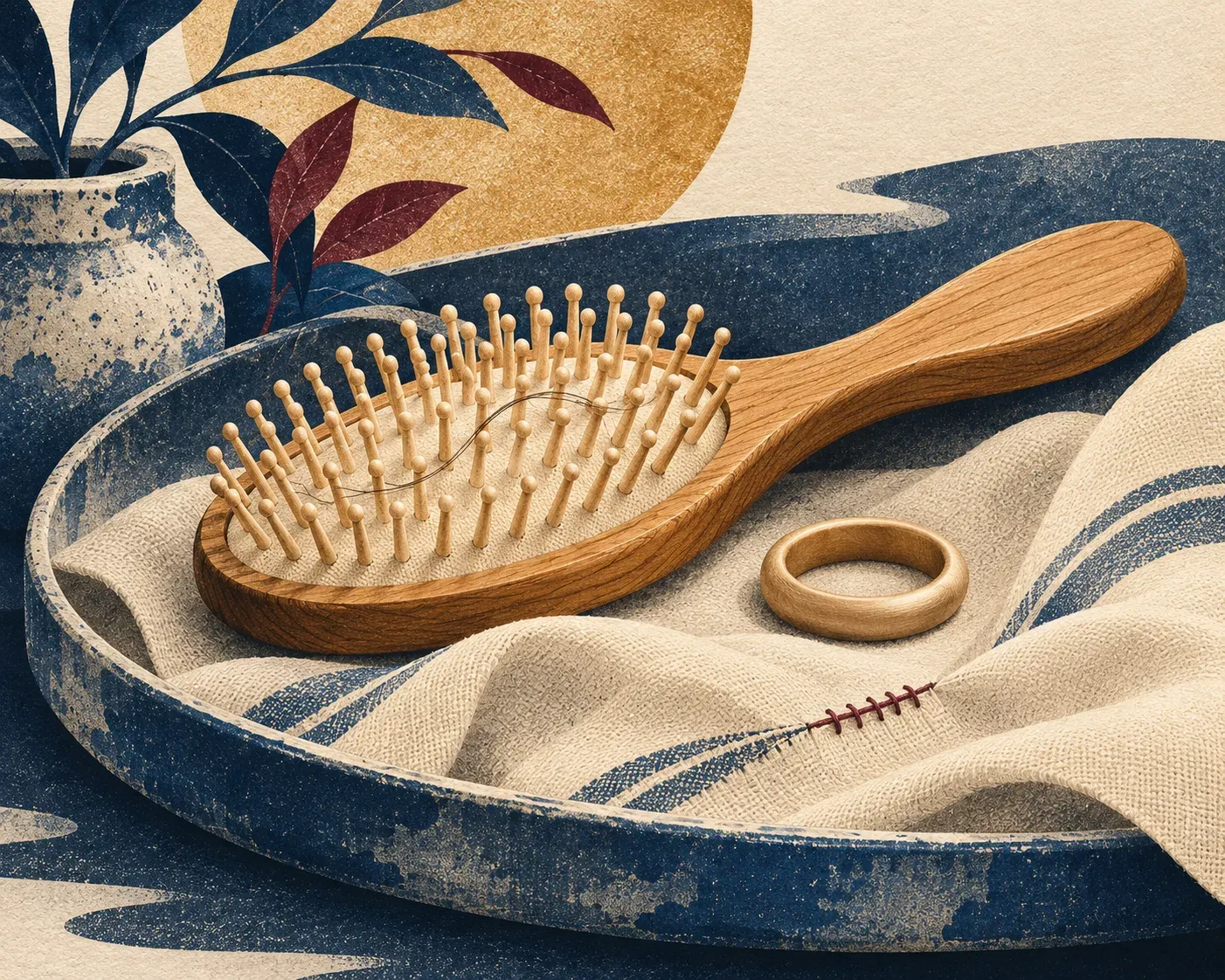
Exam week in December, Shamsunnahar Hall. Nowshin, 19, second year economics at Dhaka University, has her notes spread on the bed, a lamp, cha going cold, and her fingers in her hair, searching for the coarse strands near the crown. She does not notice until her roommate Konok lifts a small nest of hair off the pillow. “Ei, are you shedding like my cat? Use some coconut oil, na.” Nowshin laughs, says it’s stress, and drops the hair in the bin.
Home in Narayanganj for the winter break, her Nanu oils and combs her hair on the verandah in the sun, and stops. “Ki holo, here it’s thin, like a road through a paddy field.” Her mother suggests vitamins. Nowshin pins her hijab a little differently now and checks her parting in every mirror. She also picks the skin around her thumbnails until it bleeds, and keeps her hands in her lap at the dinner table.
An illustration drawn from common experience. The person is invented; the pattern is not.
Understanding hair pulling and skin picking
Trichotillomania (hair pulling disorder) and excoriation disorder (skin picking disorder) are body-focused repetitive behaviours, grouped with the obsessive compulsive and related disorders. A person pulls hair or picks skin again and again, tries to stop and cannot, and the behaviour causes hair loss or skin damage and distress. Some pulling is automatic, while reading or scrolling; some is focused, done to ease tension or to make something feel right. It is not a bad habit to be scolded, and shame is common. Anxiety often comes alongside: in a meta-analysis of 119 studies, 35.9% of people with these conditions had an anxiety disorder at some point in life.
How common are hair pulling and skin picking?
In a meta-analysis of 30 studies with 38,526 participants, about 1.14% had trichotillomania and 8.84% had some hair pulling behaviour. A 2026 global review found point prevalence of skin picking disorder ranging from 2.33% to 7.68% across population studies. Figures for Bangladesh are not available.
Signs and symptoms of hair pulling and skin picking
- Patches of thin hair on the scalp, eyebrows or eyelashes
- Pulling or picking while studying, reading, scrolling or lying in bed
- Sores or marks on fingers, face or arms that keep coming back
- Covering the area, or avoiding haircuts, mirrors or bright light
- Trying to stop many times without success
Treatment for hair pulling and skin picking
The strongest evidence is for behaviour therapy with habit reversal training. In a meta-analysis of 24 trials with 857 participants, it produced a large improvement in hair pulling compared with control conditions. Therapy helps a person notice the moments and places where pulling happens, use a competing action with the hands, such as making a fist or holding a soft ball, and change the setting, such as studying with the hair tied back. Evidence for medicines is weaker: a Cochrane review found no medicine proven to work, with early signs of benefit for a few in small trials. A psychiatrist also checks for anxiety, depression and OCD, and works with a dermatologist where a scalp or skin condition needs ruling out.
What getting better can look like
For Nowshin, it might be the next exam week: hair in a tight bun under her hijab, a soft ball in her left hand, a pen in her right, and on the pillow, nothing.
Common questions about hair pulling and skin picking
Is hair pulling a mental health problem?
When hair pulling is repeated, hard to stop, and causes hair loss or distress, it is a recognised condition called trichotillomania, or hair pulling disorder. It belongs with the obsessive compulsive and related disorders. It is treatable, and it is not a sign of weakness.
What is the best treatment for trichotillomania?
Behaviour therapy with habit reversal training has the strongest evidence, with large effects across pooled trials. It builds awareness of pulling and teaches a competing action for the hands. Medicines have weaker evidence and are considered case by case by a doctor.
When to see a psychiatrist
If pulling or picking is leaving visible marks, taking time you cannot spare, or making you avoid people, it is worth seeing a doctor. If you ever feel like harming yourself in other ways, please seek help urgently, and in an emergency call 999.
Care here is personal: built around your history, your health and what you want to change, and reviewed with you as it goes.
If some of this sounds familiar, a first conversation is a good place to start. You do not need the right words, or to be certain.
Dr. Tajreen is consulting in Uttar Badda now, until 8:00 pm. Call +880 1847-331010Every address and its hours
Sources
- Thomson et al., Journal of Psychiatric Research, 2022 (PMID 35802953)
- Jeong et al., American Journal of Psychiatry, 2026 (PMID 42415255)
- Barber et al., Journal of Psychiatric Research, 2025 (PMID 39603165)
- Farhat et al., Depression and Anxiety, 2020 (PMID 32390221)
- Hoffman et al., Cochrane Database of Systematic Reviews, 2021 (PMID 34582562)
You do not need to have everything figured out before you begin.