Understanding yourself
Burnout in doctors
“I tell my patients to rest. I haven’t in a year.”
Exhaustion, numbness and a sense of getting nowhere: burnout is common among doctors in Bangladesh, and both people and hospitals can change it.
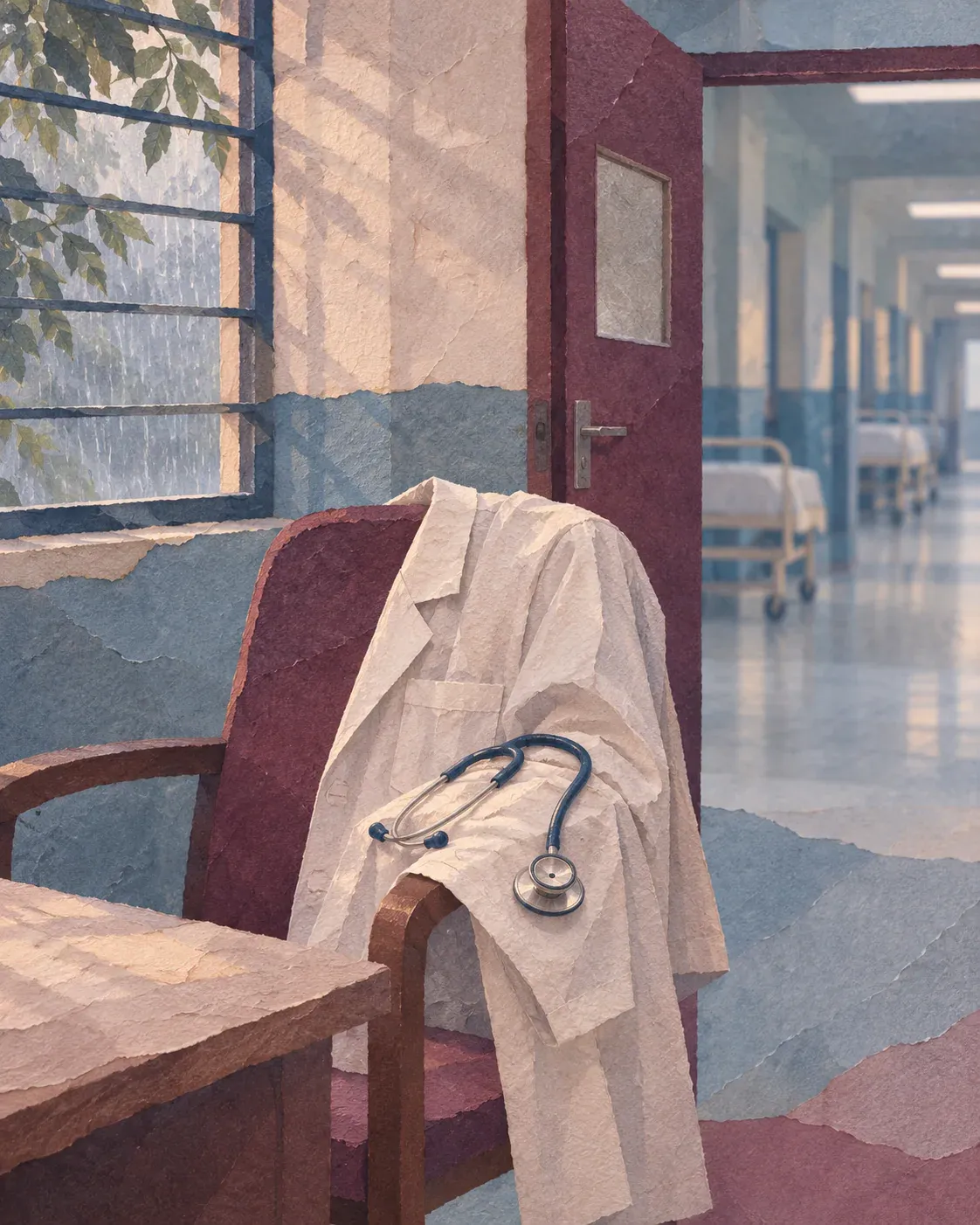
It is August, dengue season, and the medicine ward of the public hospital has patients on the floor between the beds. Dr. Shathi, 32, a medical officer, is in her twenty-sixth hour on duty. In the doctors’ room a ward boy brings steel plates of khichuri from the canteen. Her colleague Dr. Kowshik inspects his plate. “This khichuri has done more night duty than both of us.” She laughs, and then cannot remember the last time she ate sitting down.
Her mother calls while she is writing a discharge. “FCPS part two kobe? Ar biyer kotha ki bhabcho?” Shathi presses the phone between ear and shoulder. “Ammu, I tell my patients to rest. I haven’t in a year.” Last week an old man died on the ward and she felt nothing, which frightened her more. She has started snapping at relatives, and twice she has cried in the staff washroom.
An illustration drawn from common experience. The person is invented; the pattern is not.
Understanding burnout in doctors
WHO’s ICD-11 describes burnout as a syndrome resulting from chronic workplace stress that has not been successfully managed, with three features: exhaustion, growing mental distance or cynicism about the job, and reduced professional efficacy. ICD-11 classes it as an occupational phenomenon, not a medical condition. Depression, which is a medical condition, can look similar and often comes with it, so it matters to tell them apart. Doctors and nurses can also find it hard to ask for help, and may treat themselves.
How common it is
A systematic review of 182 studies of 109,628 physicians in 45 countries found burnout estimates ranging from 0% to 80.5%, largely because studies defined and measured burnout in many different ways. In Bangladesh, a 2026 survey of 703 postgraduate trainee doctors at three public medical college hospitals in Dhaka, Chattogram and Rangpur found that 70% met the study’s criteria for burnout; sleeping less than seven hours was the only factor that independently predicted it. A 2026 review of eight Bangladeshi studies reported moderate to high burnout in about 20% to over 55% of health professionals, with higher levels among female physicians, ICU doctors and those early in their careers.
Signs worth noticing
- Exhaustion that a day off does not touch
- Feeling numb, cynical or irritable with patients and relatives
- A sense that nothing you do makes a difference
- Sleeping badly even when there is time to sleep
- Self-prescribing sleeping tablets or other medicines
- Low mood, hopelessness or loss of interest outside work, which may be depression
How care helps
A psychiatrist checks for depression, anxiety, substance use and thoughts of suicide, and treats any illness found with therapy and, where it is indicated, medication. Doctors are entitled to the same confidential care they give. For burnout itself, a meta-analysis of 15 randomised trials and 37 cohort studies found that overall burnout fell from 54% to 44% after interventions, with both individual approaches and changes to how work is organised helping. Another meta-analysis found the benefits were small overall but larger for organisation-directed changes, such as schedules and workload, than for programmes aimed only at the individual doctor.
What getting better can look like
Shathi’s recovery might be swapping one night duty, seven hours of sleep twice a week, lunch eaten at a table, telling Ammu that FCPS will wait one more session, and a patient’s daughter bringing narkel naru to the ward, and Shathi feeling glad again.
Common questions about burnout in doctors
Is burnout a mental illness?
No. WHO’s ICD-11 classes burnout as an occupational phenomenon caused by chronic workplace stress that has not been successfully managed, not as a medical condition. It is described by exhaustion, cynicism about the job and reduced effectiveness. Depression can look similar and can occur alongside it, so persistent symptoms deserve an assessment.
How common is burnout among doctors in Bangladesh?
Estimates vary with how burnout is measured. In a 2026 survey of 703 postgraduate trainee doctors at three public hospitals, 70% met the study’s criteria for burnout, and short sleep was the only factor that independently predicted it. A review of eight Bangladeshi studies found moderate to high burnout in roughly 20% to over 55% of health professionals.
When to see a psychiatrist
If exhaustion and numbness have lasted for weeks, or you find yourself prescribing for your own sleep or mood, please see a colleague you trust or a psychiatrist. If you are having thoughts of ending your life, call 999 or go to the emergency department.
Care here is personal: built around your history, your health and what you want to change, and reviewed with you as it goes.
If some of this sounds familiar, a first conversation is a good place to start. You do not need the right words, or to be certain.
Dr. Tajreen is consulting in Uttar Badda now, until 8:00 pm. Call +880 1847-331010Every address and its hours
Sources
- WHO, Burn-out an “occupational phenomenon”: International Classification of Diseases, 28 May 2019
- Rotenstein et al., JAMA, 2018 (PMID 30326495)
- Hasan et al., BMJ Open, 2026 (PMID 42785940)
- Arafat and Hossain, Discover Mental Health, 2026 (PMID 42301341)
- West et al., The Lancet, 2016 (PMID 27692469)
- Panagioti et al., JAMA Internal Medicine, 2017 (PMID 27918798)
You do not need to have everything figured out before you begin.