Understanding yourself
Screens and young children
“He won’t eat a bite without cartoons.”
When a toddler will only eat in front of a screen, the whole family feels it. What the guidelines say, and how to make changes gently.
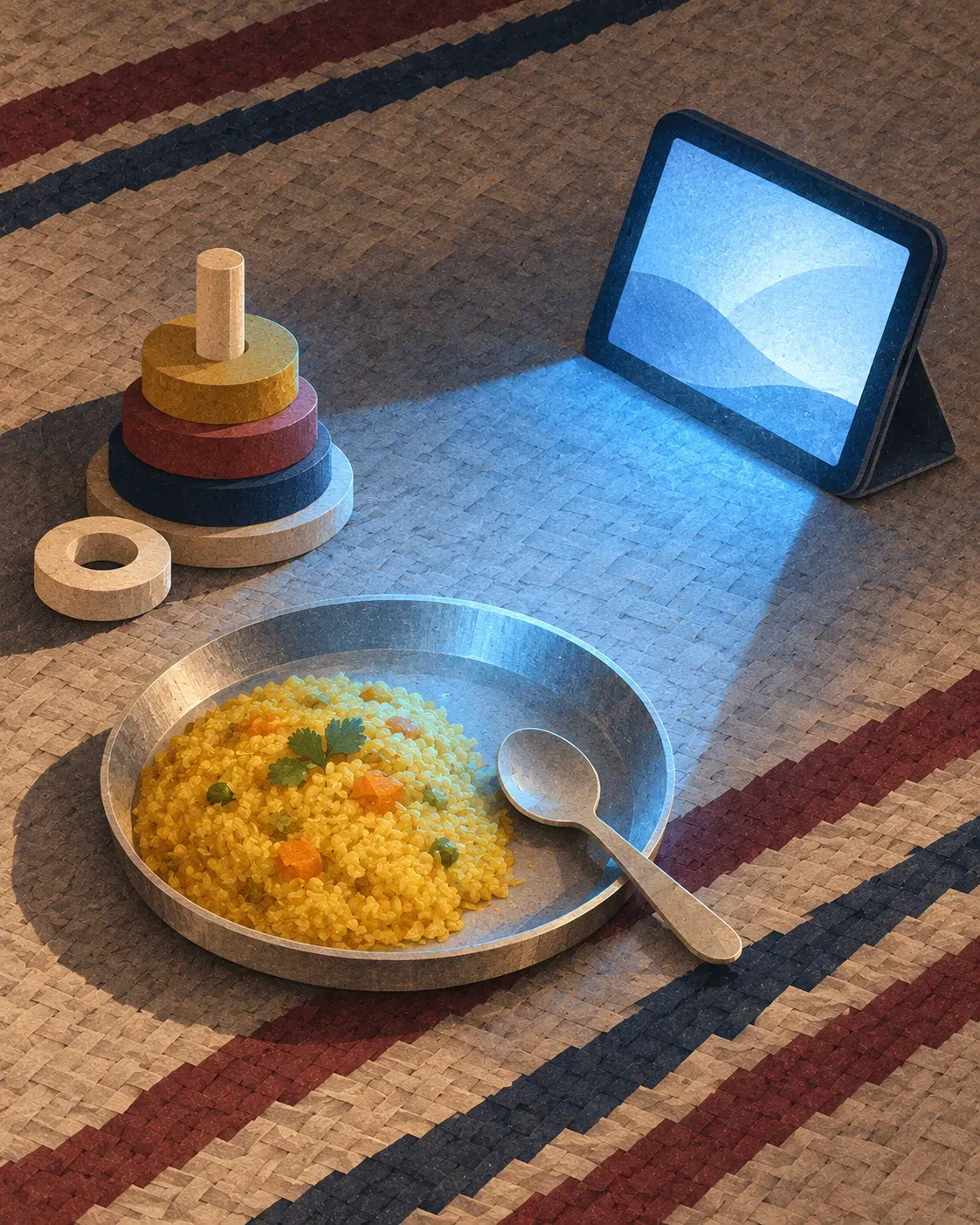
A rainy Tuesday in Kalabagan, and lunch is khichuri with a fried egg, the way Ayman, 3, likes it. Or the way he likes it when the cartoon is playing. Without the phone propped against the water jug, he turns his face away, arches his back, and screams until the neighbours’ cat leaves the window.
“In my time we fed children with stories of the crow and Chand Mama,” says his Dadi.
“Amma, your stories last two bites,” says Rima, his mother, a pharmacist who has to be back at work by three. “The cartoon lasts the whole plate.”
Everyone laughs, including Dadi, who will later admit that on weekdays, when Rima is at work, she also feeds him with the phone. Ayman’s words are fewer than his cousin’s at the same age. When the screen goes off, the tantrums are long, and the family is not sure what is normal anymore.
An illustration drawn from common experience. The people are invented; the pattern is not.
Understanding screens and young children
A toddler who will only eat with a screen is not ill. It is a habit that grows easily, because cartoons keep a child still and the plate empties fast. The concern is what screens displace at this age: talking, play, faces and the back-and-forth of a meal shared with family. If a child has few words for their age, little interest in people, or tantrums that are extreme, a doctor will want to check hearing, speech and development, and whether something more than habit is going on.
How common it is
Very common, in studies from around the world. We did not find a peer-reviewed prevalence figure for Bangladesh. WHO’s 2019 guidelines say that for children aged 2 to 4, sedentary screen time should be no more than one hour a day, and less is better; for 1-year-olds it is not recommended at all. In a meta-analysis of 63 studies with more than 89,000 children, only 24.7% of those under 2 met the no-screen guideline, and 35.6% of those aged 2 to 5 met the one-hour limit. In a Canadian study following 2,441 children, more screen time at 2 and 3 years was linked to poorer scores on a developmental screening test a year or two later; the link was small, but it ran in that direction.
Signs worth noticing
- Meals that cannot happen without a screen
- Long, intense tantrums whenever the screen is turned off
- Fewer words or less pointing and showing than other children of the same age
- Little interest in looking at faces, playing with others or responding to his name
- Screens in the bedroom, or used to settle the child to sleep
How care helps
A child psychiatrist or paediatrician will look at the whole child: speech, hearing, play, sleep, eating and growth, and will screen for developmental conditions if there are signs. Most of the work is with the family. The Canadian researchers recommend a family media plan, and that works best when everyone who feeds the child, Dadi included, agrees to it. Changes are made in small steps: the screen moves away from the plate, then off for one meal a day, with songs, picture books and simple chatter instead. Parents learn to ride out the protest calmly, because it often fades once the new routine is predictable.
What getting better can look like
Ayman’s day might include a lunch where the phone stays on the shelf and Dadi’s crow gets three bites, then five. Some evenings Rima sits on the floor with him and a picture book, and he points at the rain.
Common questions about screens and young children
How much screen time is OK for a 3-year-old?
WHO recommends no more than one hour a day of sedentary screen time for children aged 3 and 4, and says less is better. For children under 2, WHO advises against sedentary screen time altogether. Time spent reading, singing, playing and talking with a caregiver is especially valuable at this age.
Is it bad to feed a child while they watch cartoons?
An occasional screen-time meal is not usually the main concern, but if a child cannot eat without a screen, the habit can crowd out talking and family time. Moving the screen away gradually, with songs or stories instead, usually works better than taking it away suddenly. If your child also has few words or little interest in people, ask a doctor to check their development.
When to see a psychiatrist
If your child’s speech or play seems behind, if tantrums are extreme, or if mealtimes have become a daily battle, please book an appointment for an assessment.
Care here is personal: built around your history, your health and what you want to change, and reviewed with you as it goes.
If you or someone else is in immediate danger, call 999 or go to the nearest hospital emergency department.
If some of this sounds familiar, a first conversation is a good place to start. You do not need the right words, or to be certain.
Dr. Tajreen is consulting in Uttar Badda now, until 8:00 pm. Call +880 1847-331010Every address and its hours
Sources
- WHO, Guidelines on physical activity, sedentary behaviour and sleep for children under 5 years of age, news release 24 April 2019
- McArthur et al., JAMA Pediatrics, 2022 (PMID 35157028)
- Madigan et al., JAMA Pediatrics, 2019 (PMID 30688984)
You do not need to have everything figured out before you begin.